
Table of Contents:
- Introduction
- Connections with local law enforcement (formal and informal)
- Where we know ICE is formally expanding
- Companies profiting from ICE
- Where ICE is operating in our communities
- A note on being overwhelmed and paralyzed in this moment.
Opening note:
This document was pubbed in May of 2026. We invite feedback, criticism, and additions. Please let us know if you have any of those so we can work together to make this resource more helpful.
(leave a comment maybe)
Introduction
This zine is an effort to bring together existing public information about ICE in North Carolina with a focus on the Triangle Area.
The purpose of this zine is to help us get a bigger picture of ‘immigration enforcement’ in the local area along with the rapid expansions that are currently growing the state’s ability to surveil, kidnap, and deport our neighbors.
Reading through this zine may be overwhelming. The state is dedicating many resources – including money, manpower, and infrastructure – to destroy communities. For this reason, at the end of the zine, we have a few ideas for us to think through and work on together.
Overview
The connections discussed in this zine include
- Connections with local law enforcement
- ICE Expansions (proposed and underway) in North Carolina
- ICE Contracts with Local Companies
- A list of addresses related to ‘immigration enforcement’ and ICE activity
Connections with Local Law Enforcement:
Where does local law enforcement intersect and duplicate ICE operations?
There are many connections between local law enforcement (such as city police departments, county sheriffs, and other ‘public safety’ agencies) and ICE. These connections come in many forms and blur the lines between ICE and local law enforcement. Below, we categorize these connections into two groups: formal and informal.
Formal refers to the connections that exist in the form of policy, legislation, written agreements, or contracts (to name a few).
Informal refers to the connections that exist in practice, meaning that the connections have been carried out and observed in real life but may not be in official policy.
It is important to name both the formal and informal connections between ICE and local law enforcement to provide a clearer image of how they work together to accomplish similar and identical goals.
FORMAL
287(g) Program
The 287g program gives local and state police the ability to enforce certain immigration policies. Divided into 3 models, these powers allow them to do things they are not legally allowed to do under usual circumstances.
“The differences are that the Warrant Service Officer model only gives limited powers to the local agency. The Jail Enforcement Model gives more immigration enforcement powers to the local law enforcement agency, but still only within the jail operations. The Task Force model grants the most powers and effectively gives local or state law enforcement officers most of the powers of immigration enforcement agents.”
— Immigrant Legal Resource Center
These programs are enacted when an agreement is signed between local/state agencies and ICE. They are voluntary programs that are opted into and they receive no ICE funding to do so. The program is funded by local budgets. North Carolina has all three models employed in various parts of the state. Local agencies continue to adopt this program. Participating agencies include: local police departments, county sheriff departments, Department of Adult Corrections, and other ‘public safety’ agencies.
Normally, local police can only stop or arrest people based on the laws of their state. Under 287(g), designated officers can also stop, interrogate, arrest, or transport immigrants based purely on immigration violations. Generally, police cannot legally stop or detain a person just based on immigration violations. Even if they stop or arrest the person based on suspicion of a crime, they cannot legally continue to detain that person based only on civil immigration violations. But an officer who has been designated under 287(g) can. In these cases, the local police are functionally ICE agents.
Below is a list of agencies in North Carolina with 287g agreements as of February 20, 2026. As of that same date, there are no agencies in North Carolina currently in the process of adding on this program according to publicly available information.
Visit www.ice.gov/identify-and-arrest/287g for an updated list of what agencies currently have 287g agreements.
North Carolina participating agencies as of Feb 20, 2026. Taken Directly from the ICE website.
| Alamance County Sheriff’s Office | County | Alamance County | Warrant Service Officer | 5/21/20 |
| Albemarle District Jail | County | Albemarle County | Warrant Service Officer | 3/19/20 |
| Avery County Sheriff’s Office | County | Avery County | Warrant Service Officer | 7/23/20 |
| Beulaville Police Department | Municipality | Duplin County | Task Force Model | 10/17/25 |
| Brookford Police Department | Municipality | Catawba County | Task Force Model | 9/9/25 |
| Brunswick County Sheriff’s Office | County | Brunswick County | Warrant Service Officer | 7/23/20 |
| Cabarrus County Sheriff’s Office | County | Cabarrus County | Jail Enforcement Model | 3/11/20 |
| Caldwell County Sheriff’s Office | County | Caldwell County | Warrant Service Officer | 3/19/20 |
| Carteret County Sheriff’s Office | County | Carteret County | Warrant Service Officer | 5/13/25 |
| Catawba County Sheriff’s Office | County | Catawba County | Warrant Service Officer | 6/11/25 |
| Cherokee County Sheriff’s Office | County | Cherokee County | Warrant Service Officer | 3/10/25 |
| Cleveland County Sheriff’s Office | County | Cleveland County | Warrant Service Officer | 1/16/20 |
| Columbus County Sheriff’s Office | County | Columbus County | Task Force Model | 9/22/25 |
| Columbus County Sheriff’s Office | County | Columbus County | Warrant Service Officer | 3/5/25 |
| Craven County Sheriff’s Office | County | Craven County | Warrant Service Officer | 3/10/25 |
| Duplin County Sheriff’s Office | County | Duplin County | Warrant Service Officer | 6/25/20 |
| Gaston County Sheriff’s Office | County | Gaston County | Jail Enforcement Model | 6/9/20 |
| Henderson County Sheriff’s Office | County | Henderson County | Jail Enforcement Model | 6/9/20 |
| Lincoln County Sheriff’s Office | County | Lincoln County | Warrant Service Officer | 6/5/20 |
| Nash County Sheriff’s Office | County | Nash County | Warrant Service Officer | 1/29/20 |
| Newland Police Department | Municipality | Avery County | Task Force Model | 10/17/25 |
| Onslow County Sheriff’s Office | County | Onslow County | Task Force Model | 11/4/25 |
| Onslow County Sheriff’s Office | County | Onslow County | Warrant Service Officer | 3/26/25 |
| Person County Sheriff’s Office | County | Person County | Jail Enforcement Model | 2/10/26 |
| Randolph County Sheriff’s Office | County | Randolph County | Warrant Service Officer | 5/21/20 |
| Robbins Police Department | Municipality | Moore County | Task Force Model | 12/11/25 |
| Rockingham County Sheriff’s Office | County | Rockingham County | Warrant Service Officer | 12/31/19 |
| Union County Sheriff’s Office | County | Union County | Warrant Service Officer | 5/7/25 |
| Yancey County Sheriff’s Office | County | Yancey County | Warrant Service Officer | 7/20/20 |
Some of the above information on the 287(g) program is drawn from the Immigration Resource Legal Center, ‘What to Understand About the 287(g) Program’: www.ilrc.org/community-resources/what-understand-about-287g-program
SB318
Passed in July 2025, SB318 expanded HB10 which required sheriffs to verify the citizenship status of people charged with certain crimes. If a sheriff is unable to verify a person’s status, they must notify ICE. Then, if ICE issues a detainer for that person, the sheriff must hold them in jail for up to 48 hours for ICE agents to come and take them into custody. These bills: expanded the list of charged offenses that require law enforcement to determine citizenship status, delay the start time for the required 48-hour ICE detainer hold, and require jail administrators to notify ICE in advance of releasing someone who was held on a detainer. This means a person could be held for two days after being found not guilty or having their charges dismissed.
In short: SB318 compels sheriffs to check citizenship status, notify ICE, and detain folks for ICE for up to 48-hours
See the ACLU North Carolina’s website section: Immigrant Rights in North Carolina.
SB 153
Similar to SB318, SB153 is an anti-immigrant bill that seeks to force four state law enforcement agencies (Department of Public Safety, Department of Adult Correction, State Highway Patrol, and State Bureau of Investigation) to sign agreements (287g) with ICE and operate as ICE agents. Additionally, SB153 seeks to stop North Carolina public universities from having policies that limit the enforcement of federal immigration laws. This violates their autonomy and hurts their ability to function as a site of public education freely.
See El Pueblo’s ‘Policy Change’ page on their website for further information and analysis of anti-immigrant legislation in North Carolina: https://elpueblo.org/policy-change/
Fusion Center (in Raleigh)
A key infrastructure that facilitates ICE’s presence and interaction with police across North Carolina is the North Carolina Information Sharing and Analysis Center (NCISAAC). One of the more than 80 “fusion centers” created across the United States by the Department of Homeland Security in the years following 9/11, NCISAAC acts as a hub where all levels of policing are present and interact, including ICE and CBP, to monitor potential terrorist threats and other local issues that rise to a level of national security concern. NCISAAC is based in Raleigh and is staffed by the State Bureau of Investigation while enabling the federal police agencies to closely monitor issues across the state.
In practice, fusion centers are nothing more than “spycenters” that fabricate threats in order to justify intensified surveillance and policing of Black, brown, migrant, and other communities deemed to be threats to national security.
Critical information gathered from surveillance infrastructure used by local police and sheriffs across North Carolina can be shared and accessed at NCISAAC. In order to remove ICE from North Carolina, NCISAAC needs to be defunded along with the deconstruction of the surveillance infrastructure deployed in local communities.
For more information on fusion centers, please refer to the following resources:
Get the BRIC Out of Boston https://muslimjusticeleague.org/our-work/get-the-bric-out-of-boston/
Exposing Atlanta’s Security Apparatus: The Georgia Information Sharing & Analysis Center https://sassisouth.org/projects/gisac
Formal Ties Summary:
The above formal ties between ICE and local law enforcement demonstrate what some people call “crimmigration” – or in other words, the criminalization of immigration. Under the name of ‘immigration enforcement’, the state is expanding its power in the form of policing, surveillance, and captivity. These expansions result in more resources (money, manpower, and material) going towards the police and other ‘public safety’ agencies. Then, these agencies spend more time targeting, harassing, and destroying immigrant communities.
To learn more about Crimmigration, please find the Prison Policy Initiative’s resource Crimmigration resource roundup: ‘Where to find data and resources on the criminalization of immigrants which is a list of valuable online resources from organizations and agencies focused on immigration detention.’
See: https://www.prisonpolicy.org/blog/2025/04/30/crimmigration_resource_roundup/
INFORMAL
Surveillance
Georgetown Law’s Center on Privacy and Technology published a report in May 2022 titled, American Dragnet: Data Driven Deportation in the 21st Century. They found:
- ICE had scanned the driver’s license photos of 1 in 3 adults.
- ICE had access to the driver’s license data of 3 in 4 adults.
- ICE was tracking the movements of drivers in cities home to 3 in 4 adults.
- ICE could locate 3 in 4 adults through their utility records.
- ICE built its surveillance abilities by tapping data from private companies and state and local bureaucracies.
- ICE spent approximately $2.8 billion between 2008 and 2021 on new surveillance, data collection and data-sharing programs.
In May 2025, the authors released a new foreword, writing,
Given the Trump administration’s transgression of privacy and civil rights protections, we can be confident that the percentage of people whose information is captured in the driver records and utility records to which ICE has access is now much higher. In recent months we have also learned that DHS is seeking access to data from nearly every level and category of government bureaucracy. In addition to the agency’s well publicized demand for access to IRS data, for example, DHS has also attempted to access an extensive unemployment database in New Mexico and records from an elementary school in Tennessee. The data brokers and data mining companies, whose profiteering has always been parasitic upon carceral programs of the state, are newly unleashed. In April, ICE awarded Palantir a $30 million contract under which the company will provide the government with the ability to track people’s movements with “near real-time visibility.” In 2024, shortly before the presidential election, DHS entered into a $2 million contract with the Israeli corporation, Paragon, which sells spyware that allows the user to access information stored on or transmitted through cellular devices, and has been used by governments to target journalists and activists in violation of international human rights law.
As both state and private companies expand their surveillance infrastructure, everyone’s rights are damaged by ICE’s expansion.
For more on the expansion of the US surveillance state with a focus on ICE and ‘immigration enforcement’, see: AmericanDragnet.org.
For more on local efforts to challenge state surveillance infrastructure, see: SASSIsouth.org.
‘Crowd Control’
In cities with increased ICE presence (such as Minneapolis, Los Angeles, and Philadelphia), community members have reported local law enforcement working with ICE. A common way they do so is through ‘crowd control.’ When neighbors show up to defend their neighbors from being kidnapped, ICE will call on local law enforcement agencies to do ‘crowd control.’ This means local police will attempt to ‘control’ neighbors through arrest, chemical weapons (such as pepper spray or tear gas), and other forms of intimidation (long range acoustic devices, violence, threat of arrest). These are attempts to disperse neighbors so ICE can continue to kidnap without witnesses or interruption.
In this way, local law enforcement operates as ICE’s personal body guards.
Arresting neighbors protesting ICE (watching ICE)
Related to ‘crowd control’, local law enforcement will arrest, detain, and charge neighbors standing up to ICE. This is an attempt to harass and intimidate the public. Additionally, it is an attempt to break up local organizing through imprisonment. Imprisonment frequently causes loss of income, housing, and funds to meet bail and other legal fees.
Federal Agents ‘Swatting’ Neighbors
It has been reported that ICE calls the police on neighbors who stand up to them. For example, if a person is commuting behind an ICE vehicle, the ICE agents will call the police on the person. Then, they are pulled over by local law enforcement, questioned, and possibly given a traffic violation.
Informal Ties Summary
As ICE operates as a personal paramilitary force for the federal government, and local law enforcement routinely operates as an extension of their reach. ICE and local law enforcement work together: from directly contributing to ICE operations through kidnapping and detainment, to assisting ICE’s ability to function through surveillance and the repression of resistance.
ICE Expansions: Where is ICE planning to formally expand operations as of April 2026?
ICE is growing very fast – specifically, it has more than doubled since 2025 between the self-titled “ICE surge” and the recently released “ICE Detention Reengineering Initiative.” It is clear that they will keep expanding. As reported in a WIRED article, ICE and DHS are expanding ICE’s physical presence across the country. This will involve creating new facilities in every state.
North Carolina is not safe from ICE’s expansion. Over the last few months, various reports (in the form of leasing documents, federal records, and other government records) reveal plans to create and expand detention centers and offices all across North Carolina. As of March 2026, facilities were proposed in Winton, Greensboro, Cary, Charlotte, and Concord, NC.
WHAT DO WE KNOW?
A few offices already exist in NC, including in Charlotte and Cary.
- Office of the Principal Legal Advisor in Charlotte, NC: 5701 Executive Center Drive, Suite 300
- Homeland Security Investigations Office in Charlotte, NC*: 3700 Arco Corporate Drive, Suite 300
- Office + hold room in Cary, NC: 140 Centrewest Ct
- Field Office + hold room in Charlotte, NC: 6130 Tyvola Centre Drive
Here is a list of the proposed new and expanded offices plus detention centers in NC:
Detention center (Rivers correctional facility) in Winton, NC
- Address: 145 Parker’s Fishery Road, PO Box 840, Winton, NC 27986
- Owner: GEO
- Uncovered by ACLU FOIA
Detention center (Former American Hebrew Academy) in Greensboro, NC
- Address: 4334 Hobbs Road, Greensboro, NC 27410
- Owner: Baptiste group
- Uncovered by ACLU FOIA
Field Office in Cary, NC
- Address: 11000 Regency Lakeview, Cary, NC
- Leasing company: Foundry Commercial
- Building owner: BDS II NC Regency Lakeview LLC
- Reported in WIRED article
Field Office in Charlotte, NC*
- Address: Whitehall Corporate Center, 3700 Arco Corporate Dr, Suite 300
- Reported in WIRED article
Warehouse detention facility in Concord, NC
- Address: 7250 Weddington Rd, Concord, NC
- Seems to be owned by Crescent Communities, LLC
- Reported in NYT article
*Charlotte Homeland Security Investigations office is listed as an [existing field office] on the ICE website and as a [planned location for new + expanding ICE offices] in a WIRED article – Our current assumption is that it is expanding.
See: ICE Is Expanding Across the US at Breakneck Speed. Here’s Where It’s Going Next by Leah Feiger in WIRED for further details.
See: ACLU’s report: FOIA Response – Washington Field Office Detention Expansion. Document Date: January 29, 2026. https://www.aclu.org/documents/foia-response-washington-field-office-detention-expansion.
ICE Money: Who are the local companies profiting from ICE?
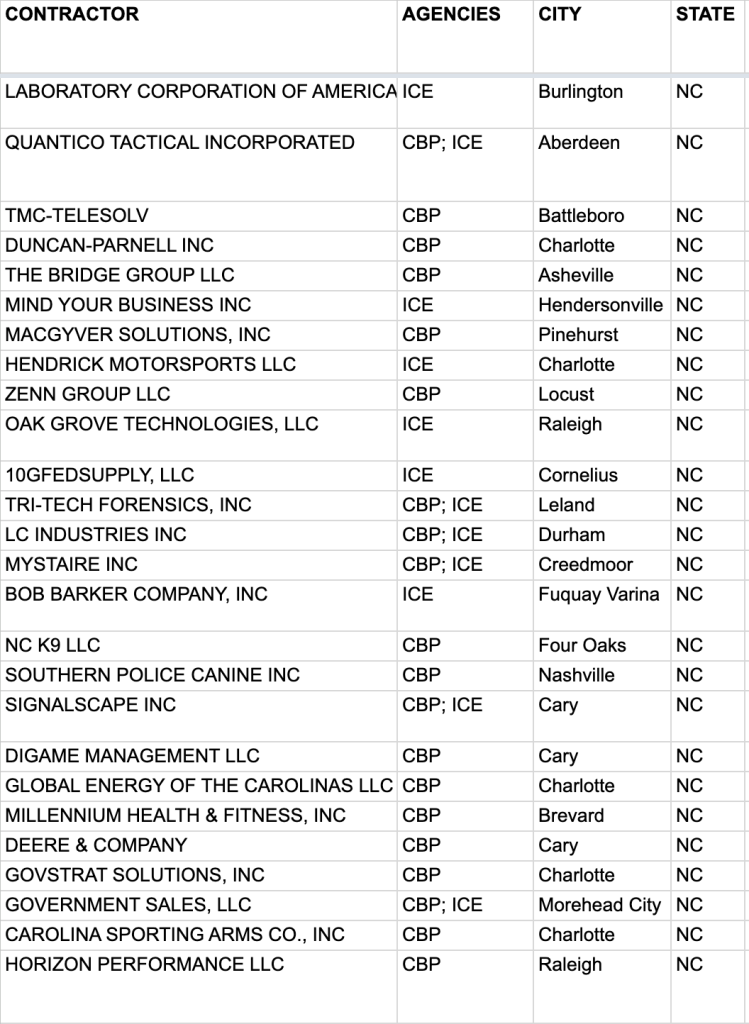
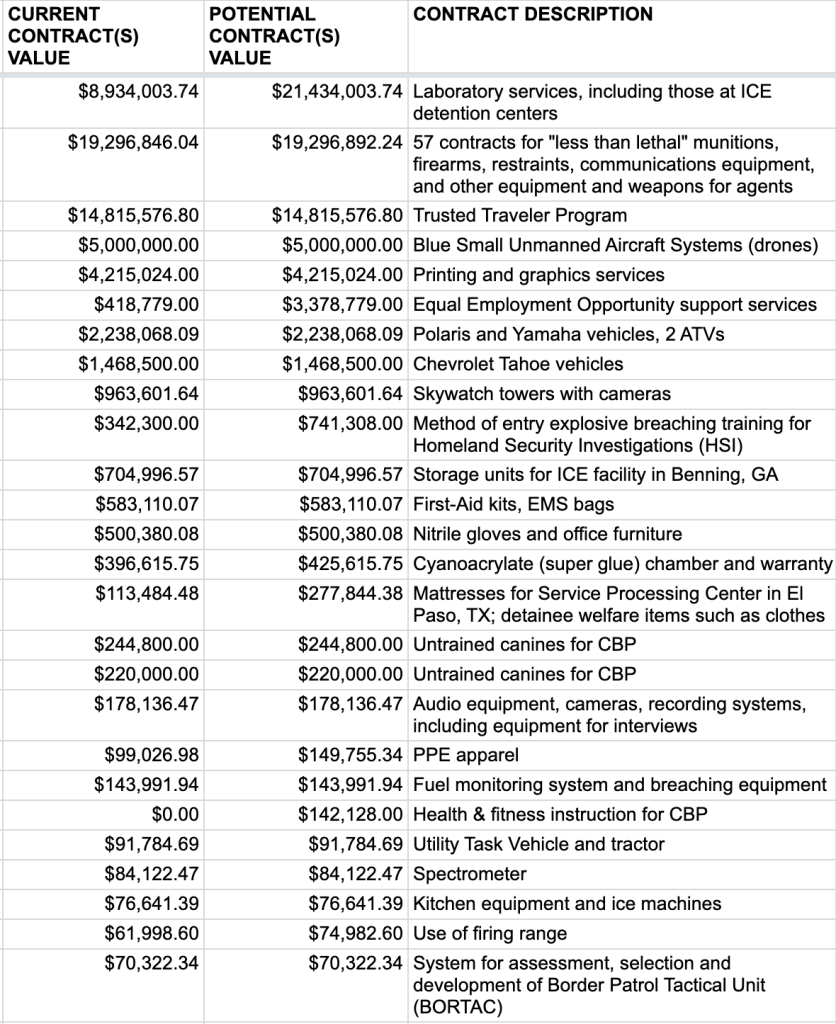
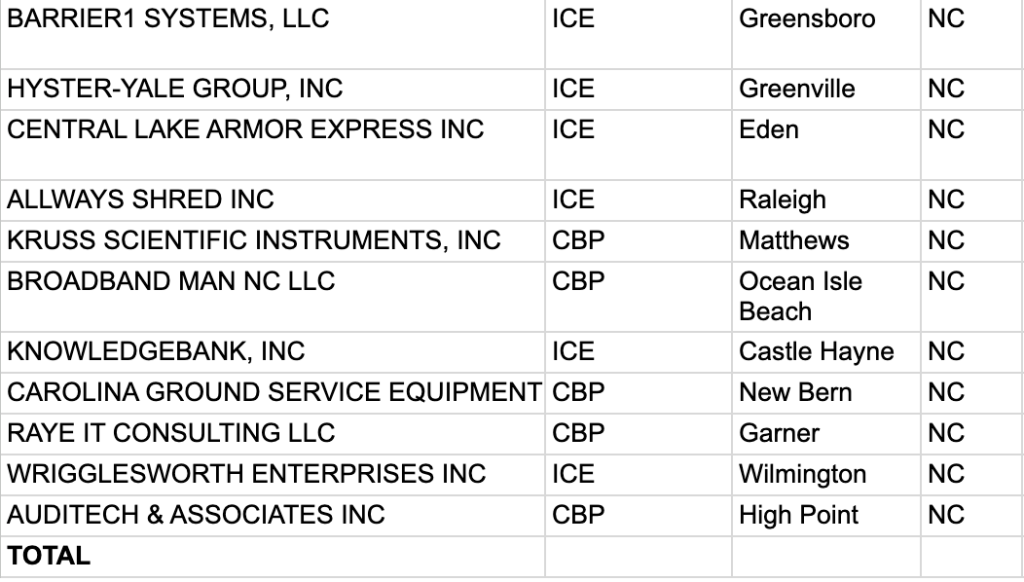
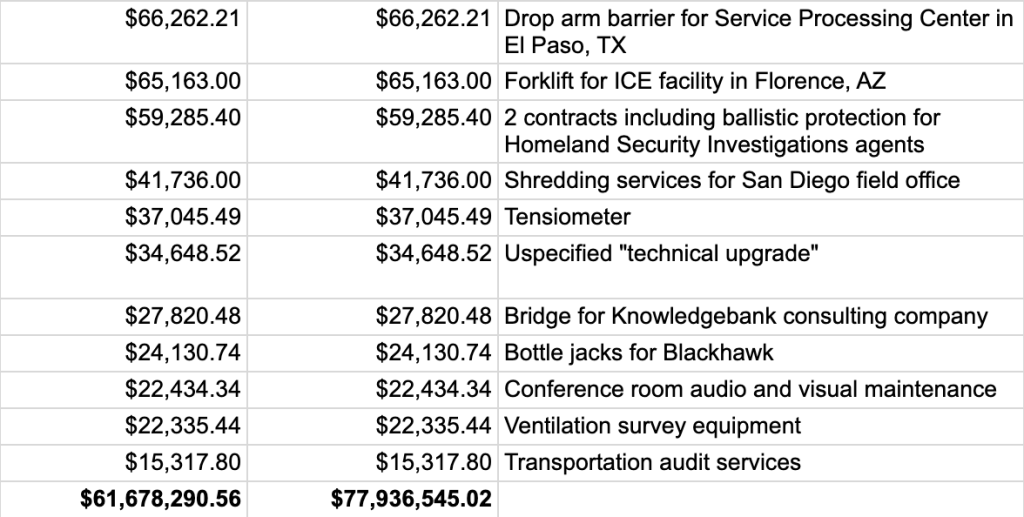
In December of 2025, Facing South, an online magazine of the Institute for Southern Studies, released a report of ICE and Border Patrol contracts. Based on federal spending data, they identified 38 companies headquartered in North Carolina that had contracts with ICE and CBP for 2025-2026.
These contracts range from laboratory services and mattresses to “untrained canines” and “less than lethal chemical munitions.”
COMPANY HIGHLIGHTS!
Quantico Tactical Incorporated produces chemical weapons, munitions, and other military-grade weaponry used by police and those carrying out ‘immigration enforcement’
Horizon Performance LLC contributes to the hiring and training of BORTAC agents, a notorious CBP unit known for their brutality.
Addresses of Note: Where is ICE operating in our communities?
| Category (parking lot, court, repeated raid site, jail, airport) | Name | Jurisdiction/scale (municipal, county, state, federal) | Address | Description | Note |
| Federal Facilities | Cary ICE Office | Federal | 140 Centrewest CourtCary, NC | ICE Field Office, Temporary Detainment/Transfer location | Some of those detained in the Triangle in Nov. 25 were taken from the Cary field office before being transferred to New Hanover County Jail. *Raleigh hold room listed at this address |
| Charlotte ICE office | Federal | 6130 Tyvola Centre Drive | ICE field office | *Charlotte hold room listed at this address This is also the only office in NC listed as a check-in location | |
| Charlotte OPLA office | Federal | 5701 Executive Center Drive, Suite 300Charlotte, NC | Office of the Principal Legal Advisor, Atlanta – field office | ||
| Charlotte HSI office | Federal | 3700 Arco Corporate Drive, Suite 300 | Homeland Security Investigation Office | ||
| Fusion Center (North Carolina State Bureau of Investigation-NCISAAC) | Federal, state, and local | 3320 Garner Rd. Raleigh NC, 27610 | |||
| Atlanta Field Office | Federal | 180 Ted Turner Dr SW #522, Atlanta, GA 30303 | Headquarters for the Southeast. Houses the Field Office Director | ||
| USCIS(US Citizen and Immigration Services) | USCIS Raleigh-Durham Field Office | Federal | 301 Roycroft Dr, Durham, NC 27703 | NOTE: Detainments at immigration appointments at USCIS offices have continued across the state. | |
| USCIS Charlotte Field Office | Federal | 201 Regency Executive Park Dr, Charlotte, NC 28217 | |||
| USCIS Application Support Center (ASC) Raleigh | Federal | 10954 Chapel Hill Rd #101, Morrisville, NC 27560 | |||
| USCIS ASC Charlotte | Federal | 910 E Arrowood Rd, Charlotte, NC 28217 | |||
| USCIS ASC Atlanta, GA | Federal | 3358B Chamblee Tucker Road, Atlanta, GA 30341 | |||
| USCIS ASC Greer, SC | Federal | 501 Pennsylvania Avenue, Greer, SC 29652 | |||
| USCIS ASC Norfolk, VA | Federal | 5678 East Virginia Beach Boulevard, Norfolk, VA 23502 | |||
| USCIS Asylum Office Arlington | Federal | 1525 Wilson Boulevard, Suite 300, Arlington, VA 22209 | |||
| Courts | Durham County Courthouse | County | 510 S Dillard St #2000, Durham, NC 27701 | Immigration proceedings do take place here. | |
| Charlotte Immigration Court | 5701 Executive Center Dr, Suite 400, Charlotte, NC 28212 | ||||
| Jails | County Jails are operated by the county sheriff who is an elected official. | All NC jails are listed and mapped by county on Siembra’s Ojo Obrero resource under the ‘Jail’ tab. Jails are locations where detained persons are often held before deportation; site of municipal/county level collaboration. SB153 and 318 deputize all state and local law enforcement, including jails to cooperate with ICE and other federal agencies with immigration enforcement. | |||
| Alamance County Detention Center | County Alamance County Sheriff: Terry Johnson | 109 S Maple St, Graham, NC 27253 | Before Fall 2025 escalations, those detained were taken here. | 11.19.25: Sheriff announced the facility would no longer be accepting, housing, or transporting ICE detainees. This is due to stricter bail rules as part of Iryna’s Law leading to operational constraints. | |
| New Hanover County Jail | County New Hanover County Sheriff: Ed McMahon | 3950 Juvenile Center Rd, Castle Hayne, NC 28429 | Triangle area folks detained by ICE in November 2025 were taken here. | ||
| Cabarrus County Jail | County Cabarrus County Sheriff: Van W. Shaw | 40 Corban Ave SE, Concord, NC 28025 | Dara on ICE detentions via deportationdataproject (DDP) available. | ||
| Forsyth County Jail | County Forsyth County Sheriff: Bobby F. Kimbrough, Jr | 201 North Church Street, Winston-Salem, NC 27101 | One detention listed in DDP dataset. | ||
| Franklin County Detention Center | County Franklin County Sheriff: Kevin White | 285 T Kemp Road, Louisburg, NC 27549 | Per DDP, few detentions UNTIL February 2026 | ||
| Gaston County Jail | County Gaston County Sheriff: Chad Hawkins | 425 Dr M.L.K. Jr. Way, Gastonia, NC 28053 | Per DDP, no detentions here since 2025 | ||
| Henderson County Detention Center | County Henderson County Sheriff: Lowell Griffin | 375 First Avenue East, Hendersonville, NC 28792 | Per DDP | ||
| Onslow County Jail | County Onslow County Sheriff: Christopher D. Thomas | 717 Court Street, Jacksonville, NC 28540 | Per DDP, few detentions UNTIL late august 2025 | ||
| Hold Rooms* | Charlotte Hold Room | 6130 Tyvola Centre Drive, Charlotte, NC | *located at Charlotte ICE field office | ||
| Hendersonville Hold Room | 518 6th Avenue West, Hendersonville, NC | ||||
| Raleigh Hold Room | 140 Centrewest Court, Cary, NC | *located at Cary ICE field office | |||
| Airports | Charlotte Douglas International AirportCode: CLT | Often agreements at the county level. See Flight Tracking resource for more details and potential action items. | 5501 Josh Birmingham Pkwy, Charlotte, NC 28208 | Sites of known deportation transfers and flights. | |
| Piedmont Triad Airport, Greensboro Code: GSO | 1000 Ted Johnson Pkwy, Greensboro, NC 27409 | ||||
| Proposed Expansion | Winton, NC proposed Detention Center | 145 Parker’s Fishery Road, PO Box 840, Winton, NC | Proposed detention center located at Rivers Correctional Facility | Owner: GEO ACLU FOIA 3/23/26: Lewandowski reportedly told DHS official not to award GEO any more contracts | |
| Greensboro, NC proposed Detention Center | 4334 Hobbs Rd, Greensboro, NC 27410 | Proposed detention center located at former American Hebrew Academy | Owner: Baptiste group ACLU FOIA 02/20/26: City council changed zoning laws to make it more difficult for detention centers to be built. Locals demand they do more. | ||
| Concord, NC proposed Warehouse Detention Center | 7250 Weddington Rd, Concord, NC | Proposed Warehouse | (seems to be) owned by Crescent Communities, LLC NYT article 4/1/26: PBS reported that DHS is pausing + scrutinizing warehouse purchases | ||
| Cary, NC proposed new ICE office | 11000 Regency Lakeview, Cary, NC | Proposed ICE office | Leasing company: Foundry Commercial Building owner: BDS II NC Regency Lakeview LLC WIRED article | ||
| Charlotte, NC proposed ICE office | 3700 Arco Corporate Drive, Suite 300 | Proposed expansion of existing ICE office at Whitehall Corporate Center | |||
*Revealed by the Colorado Times Recorder: ICE is keeping tens of thousands of detainees in 170 secret “hold rooms” across the country, including at least three sites in North Carolina. The “hold rooms” are not publicly known. ICE agents do not follow the rules for how long detainees can be kept there.
“Located in warehouses, strip malls, office parks, and ICE substations, the facilities are held to different standards than the agency’s official detention facilities,” the Times Recorder reported. “They are not permitted to contain beds, and are not required to contain toilets.”
See “ICE is keeping detainees in three undisclosed “hold rooms” in North Carolina, new report says” in Cardinal & Pine for more.
Don’t panic! Closing Remarks
Within this zine, we attempted to bring together what we know about ICE presence and operations in North Carolina based on publicly available information. There are a lot of connections. It may feel overwhelming. However, this means, there is work for us to do together, and there’s certainly enough work to go around!
As we continue bringing together these connections, we can paint a bigger picture of ICE in our state. The hope is that with this clearer image, we can better strategize how to resist them.
Through our awareness and analysis, we can ask and then answer for ourselves:
- What makes deportations possible?
- What are the functions necessary to kidnap our neighbors?
- What connections are necessary for the deportation machine to run?
- What can we do today to make surveillance, detainment, and deportation less likely tomorrow?
- Where can we apply public attention, accountability, shame, and penalty on those who collaborate with ICE?
Key sites for consideration include surveillance and incarceration. Both serve to expand state and private actors’ abilities to capture and hold captive an increasing number of people.
To plug into organizing against surveillance locally, see: Southerners Against Surveillance Infrastructure at SASSISouth.org or contact sassisouth@proton.me
To plug into organizing against jail, prison, and cage expansions, see: Fight Toxic Prisons at ToxicPrisons.com and @FightToxicPrisons on Instagram.
To plug into organizing against ICE detention expansion locally, see: NO ICE IN CARY at durhamresistance.com/noiceincary and the Stop Detention Centers NC group – talk to the person who gave you this zine about getting involved.
To plug into your community, talk to your neighbors – no really! From co-workers to congregants to your local mutual aid hub, people care about the things you care about. Go find them!
For further research on ICE detention expansion see: Project Saltbox at www.projectsaltbox.com, and Deportation Data Project at deportationdata.org
This work would not be possible without local journalists, autodidacts, and neighbors everywhere– thank you!

For printable versions of this zine and others such as, “ICE Flight Tracking & The Limitations of Remote Flight Tracking” and “How to Respond to Raids,” visit TheOutsideAgitator.com.

any input?