
Reportback: A Fig Tree Grows in Palestine, A Fig Tree Grows Here
The below speech was edited for clarity.

Introductory speech
Welcome everyone!
Thank you so much for coming to celebrate the opening of A Fig Tree Grows in Palestine, A Fig Tree Grows Here in the Alumni Sculpture Garden.
This project grew out of a special topics class last semester, Art as Social Action: On Guantanamo, Statelessness, Art, and Liberation. In this class, we explored social practice strategies while simultaneously investigating one physical site and the critical social, political, and aesthetic questions it raises: Guantánamo Bay Detention Center. In collaboration with UNC law professor Deborah Weissman and her Human Rights Policy Lab, we discussed the legal and ethical dimensions of incarceration and torture within a framework of both law and art practice. The course was grounded in an historical understanding of the creation of Guantánamo as a moment in the U.S. and the West’s long colonialist expansion and anti-Arab politics which we tragically saw playing out in the current war against Palestinians. In that class, we mounted an exhibition and took part in a symposium with former Guantanamo detainees and developed the sculpture project A Fig Tree Grows In Palestine, A Fig Tree Grows Here. And it was this project that we were able to bring to fruition with my current class.
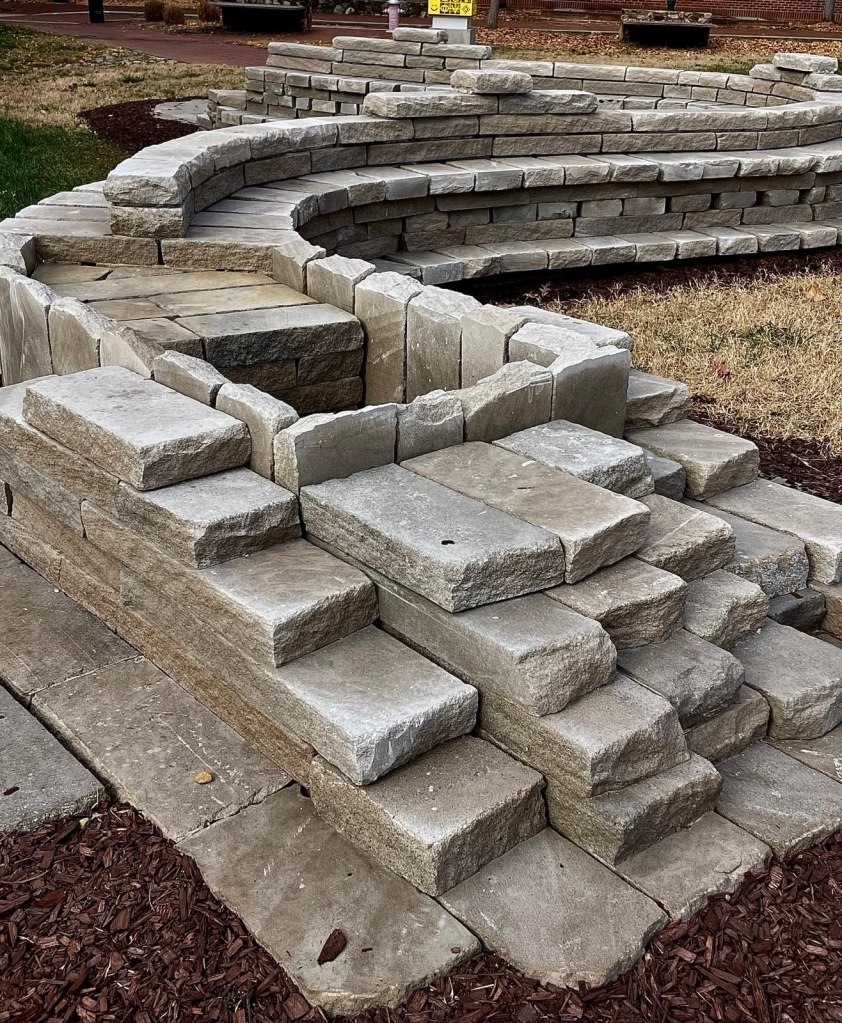
This semester, we studied artistic strategies for art as social action alongside the themes of borders, architectures of violence, and displacement, with a focus on Palestine, to prepare us for developing the sculptural proposition from last semester. We worked…to learn about limestone to think about the history of working with this material in the context of Palestinian architecture. We began in late October to build the sculpture, learning as we went along, and spent hours moving 50 to 100 pound pieces of stone, stacking and unstacking to learn how to create rhythm and form.
This project has emerged from a time of immense sorrow and pain as we have continued to see the horrific violence being waged against Palestinians, but also an intense time of hope as we learned and worked together on creating something that could continue to cultivate a space of shared growth. This sculpture is a witness to the ongoing and totalizing violence of Israeli settler colonialism but also a testament to the strength of solidarity and the power of grieving together.
I want to say how grateful I am to my students, grateful to them for how much they have taught me and how much we have learned together in this process. It has taken incredible dedication and mutual care to bring this sculpture to life, and I am truly honored to have been able to work alongside you all to create this together. Thank you for all your rigorous thinking and deep commitment to creating an artwork that attends to the nuances of such a meaningful and urgent subject, and one that aims to foster care and collective learning.
…
So today is a day of celebration of the completion of this project but also a day of reflection. I am honored to introduce a student who taught us so much. They went home to the West Bank this past summer and brought back stones which we have placed in the sculpture. She will give our final opening remarks. Please help me welcome them to the mic.
Thank you so much.

Artist Statement
A Fig Tree Grows in Palestine, A Fig Tree Grows Here is a sculpture that functions as both a tribute and an invitation. It is simultaneously a boundary and a gathering space, dividing but also connecting people. Built entirely out of limestone, a commonly used architectural material in Palestine, the sculpture references Palestine’s historic dry stacked stone structures. Shaped like a wall, but also like the winding Jordan River as it meets the Galilee Sea, the work suggests architecture’s role in defining spaces of exclusion, control and surveillance, but ultimately subverts its intentions. This dual purpose of our sculpture speaks to the contradiction inherent in all walls: while they control and divide, they also confront people with the presence of the “other” on the other side. This is the layered nature of borders under settler colonialism: the attempt to erase and the failure to fully do so.
We have also planted a fig tree that we hope will thrive. It is a symbol of Palestinian culture, and its planting here an assertion against erasure. It is a reminder of the resistance against the violence of settler colonialism. A Fig Tree Grows in Palestine, A Fig Tree Grows Here invites play and engagement; it invites gathering and communing. A firepit grille offers a space to cook and eat together. We drew upon ideas of the commons, and Al Masha, which in Arabic refers to communal land equally distributed among farmers. Artists and architects Sandi Hilal, Alessandro Petti and Eyal Weizman write: “Al Masha can only exist if people have decided to cultivate the land together. The moment they stop cultivating this land, they lose possession of it. Thus, in order for Al Masha land to come into being, it must be activated and its possession continuously enacted by common use. Today we may ask: is it possible to reactivate the cultivation of the rural commons, expanding the meaning of cultivation to other human activities that imply a common taking care of life?” We hope that this space becomes a space cultivated by all of us, a space where we take care of each other.
Speech
hello everyone,
thank you for joining us today
I may not be the best at giving speeches, but as a palestinian woman, I feel that I must say something.
First of all,
I feel privileged to even be here.
I was born in the west bank, specifically Ramallah, which is only 50 miles from Gaza. Had I been born just slightly west, I wouldn’t be standing before you on this campus. That reality eats me alive – that my people are hiding from drone strikes and raining missiles, while I comfortably give a speech about art in a foreign land.
I’ve been glued to the news and my phone, reading about the devastation in Gaza.
I remember seeing a girl desperately searching for her father under the rubble, pleading to God, pleading to the rubble, pleading to anyone to spare his life.
On the other side of the screen, I watch her discover the remaining shreds of his clothes, and I can only watch as she sobs.
she sobs, and I am here, giving a speech not looking for my dad under the rubble
Here I am, standing before you, and here she is, witnessing the annihilation of her loved ones before her very eyes.
The guilt I feel is immeasurable. We are both palestinian, but our realities are so stark so unfair
she has been surviving a year-plus ethnic cleansing campaign that my tax dollars and tuition are funding.
and there’s nothing I can do about it.
i cant stop the bombs
i cannot shield that girl from her grief
but what i can do, what I’m trying to do right now, is tell that girl’s story
give her a voice
i will speak even louder, trying to break the deafness of this world
When this is your reality – having your very existence be belittled
watching your people being blown up to bits on live tv in high definition
– you begin to resent yourself and your own identity. And I have resented my identity as a palestinian for a long time.
i hated the fact that, simply by existing, I am a political statement.
Online, people take liberties arguing that Palestine is a figment of imagination, an error in our collective consciousness.
but i am here.
I exist.
i hated the sour looks i got for saying I’m Palestinian
i hated the accusations
i hated the alienation
i hated everything about being Palestinian, being treated like a ghost or a terrorist
it all was confusing since I’ve always thought that i was human – an equal being that bleeds the same blood and dreams the same dreams.
however The looks in people’s eyes told me: “you’re not like us – you’re palestinian.”
but regardless of that,
i loved palestine
i loved the air of palestine
i loved our olive groves
our fig trees
our skies, our mountains, our shops, our streets
oh, i love palestine
and the reality is
no matter how beautiful the place, how deep the culture – when guns are waved in your face and soldiers glare at you, ready to shoot you dead, you can’t help but build resentment.
and my resentment was misplaced, it was never about palestine but it was for this cruel unjust world
now i know that i resent everything everything but palestine
i resented the settlers that stole my dads beautiful land
a land that I’ve never stepped foot in
That I can only dream about through my dad’s stories
he tells me how huge the land is
with a winding creek and fig trees growing at its sides.
the fig trees would always bear the sweetest fruit you could imagine
and the creek’s water was so pure.
he shows me the papers that prove our legitimate claim to this land
but nearby settlers had claimed it, and took it from us by force
I also resented both the fact that we had lost so much and that I wasn’t strong enough to personally take action. I was no ahed tamimi, slapping a soldier across the face as he attempted to abduct her 13 year old brother.
I was no alice Kisiya, shouting at the settler stealing her house in bethlehem
i never screamed
i never slapped a soldier across the face
i just resented
Now, i realize that we must all be like Ahed and Alice
slapping our oppressors “figuratively ofc”
making art that pushes boundaries
Proving that we exist
because my mere existence is proof that their genocidal project has failed
as
david bengurion the first prime minister of israel once said
“the old will die
and the young will forget”
But i didnt forget
And I will never forget
As long as a live, up until my final breath,
i will yell
i will shout
i will prove that Palestine exists because it’s within me – in my heart, in my work, and my art.
and
When i die, it won’t be quietly.
I will scream with the injustices that I’ve faced for being palestinian
since
The whole world seemingly wants palestinians to die silently
to starve quietly
to meet their ends without protest
but We bother them when we’re too loud,
And that’s exactly my plan – to bother them, to upset this system of suffering, one piece at a time.
I’d like to thank my professor for putting this project together with me and my classmates. You’ve all brought a piece of palestine to this campus through motnhs of work, and for that, I can’t thank you enough.
thank you for making this event come to life.
I truly believe that this piece will one day speak for itself, reminding the world (or at least chapel hill) that Palestine isn’t going anywhere.
Thank you to everyone who fought for this monument to my precious homeland, and thank you all for your time.

To peruse further: see the installation’s website and accompanying Zine.
To view the sculpture in person, you can find it in the Alumni Sculpture Garden located behind the Kenan Music Building, between Swain Hall and Hanes Art Center.

